How to Start Dropshipping in the UK: A Step-by-Step 2026 Guide
 I ★★★★★ 4.7 on
UK-based · Founded 2018

Source smarter with verified UK suppliers and automate every order with Avasam.
Key takeaways
✅ Dropshipping is legal in the UK – you operate as a normal retailer with consumer rights, tax, and product-safety obligations.
✅ Register first. Choose sole trader (simplest) or limited company (limited liability) and declare income to HMRC.
✅ VAT registration is generally required once taxable turnover exceeds £90,000 in a rolling 12-month period, or if you expect it to exceed £90,000 in the next 30 days. You can also register voluntarily below the threshold.
✅UK suppliers can offer faster domestic delivery, depending on the supplier, product and fulfilment service, while also reducing the customs and import complexity associated with overseas sourcing.
✅ Low start-up cost. Expect to budget for a selling platform, an automation tool, a domain, and marketing – not inventory.
✅ It’s a real business. Success comes from niche choice, reliable suppliers, and marketing, not a get-rich-quick mindset.
What's in this guide
Is dropshipping legal in the UK?
Yes, dropshipping is completely legal in the UK. It is a recognised retail fulfilment model, not a loophole, and businesses of every size use it. The legal responsibilities are the same as for any UK retailer: you must describe products accurately, honour consumer rights and returns under the Consumer Rights Act 2015, protect customer data under UK GDPR, pay the correct tax, and sell only products that are safe and legal to sell in the UK.
What are my legal responsibilities as a UK dropshipper?
Your main responsibilities include providing accurate product information, following UK consumer and returns rules, handling customer data lawfully, meeting your tax obligations, and checking that products comply with applicable safety requirements. Because you are the seller of record, you – not the supplier – are responsible to the customer. Read our dedicated guide on whether dropshipping is legal in the UK for details.
How to Start Dropshipping in the UK Step by Step
To start dropshipping in the UK, choose a suitable niche, understand your business and tax obligations, find and vet a reliable supplier, choose where to sell, list your products and set up a reliable process for fulfilment and customer support. You do not need to buy inventory upfront under the traditional dropshipping model.
Starting a dropshipping business in the UK is a straightforward process when broken into clear steps. First, confirm that the products you want to sell comply with UK regulations. Next, register your business, understand your tax obligations, select a niche with proven demand, source reliable suppliers, build your online store, and automate operations wherever possible.
Many new retailers overcomplicate the process. In reality, the fastest route to launching is to choose a reliable supplier network, focus on a specific niche, and start testing products while learning from customer feedback and sales data.

Step 1: Register your business (sole trader vs limited company)
Before you start trading, choose the business structure that is appropriate for your circumstances and understand your registration and tax obligations. Many UK businesses operate as sole traders, while others choose a limited company.
If you operate as a sole trader, you may need to register for Self Assessment with HMRC. If you set up a limited company, you generally register the company with Companies House and deal with the relevant tax obligations.
| Factor | Sole Trader | Limited company |
|---|---|---|
| Setup | Quick, register with HMRC for Self Assessment | Register at Companies House + HMRC |
| Liability | You are personally liable for debts | Limited – company is a separate legal entity |
| Tax | Income Tax on profits | Corporation Tax on profits |
| Admin | Lighter | Heavier (annual accounts, confirmation statement) |
| Best for | Testing the model, lower turnover | Scaling, protecting personal assets |
Many UK dropshippers start as a sole trader to test the model with minimal admin, then incorporate once profits and risk grow. This decision affects how you pay tax, so it is worth a short conversation with an accountant. Our UK dropshipping tax guide compares both routes in full.
💡 Automate Your Dropshipping Business
Manually processing orders limits growth. Avasam automatically routes orders, synchronises stock levels and updates tracking information across your sales channels, allowing you to focus on growing your business.
Step 2: Understand VAT and tax
You do not generally need to register for VAT when you start dropshipping in the UK. Registration is required if your taxable turnover exceeds £90,000 in a rolling 12-month period, or if you expect it to exceed £90,000 in the next 30 days. You can also register voluntarily below the threshold.
The £90,000 VAT registration threshold has applied since 1 April 2024 and is the same for sole traders, partnerships and limited companies across the whole of the UK. The deregistration threshold is £88,000. Some sellers register voluntarily before reaching the threshold so they can reclaim VAT on start-up costs – whether that benefits you depends on your margins and customers.
Do you need a VAT number to dropship in the UK?
No, not to begin. A VAT number is only legally required once you cross the £90,000 threshold, though you may choose to register voluntarily earlier. If you sell to customers in the EU, separate rules and the EU’s €10,000 cross-border threshold can apply – see our Brexit & UK dropshipping guide. You will also pay Income Tax or Corporation Tax on profits and must keep accurate records; our UK VAT guide for dropshippers covers it step by step.

Step 3: Choose a profitable niche
A profitable UK dropshipping niche combines genuine demand, healthy margins, manageable competition and products that are practical to ship domestically. Bulky, fragile or regulated items are far easier to sell when sourced from a UK supplier rather than shipped from overseas.
What are the best dropshipping niches in the UK?
Consistently strong UK categories include home & living, garden & outdoor, health & beauty, pet supplies and electricals. Fashion remains the single largest dropshipping segment globally, holding roughly a third of market share (Grand View Research) though it is also the most competitive, so many UK sellers do better in a focused sub-niche. Research demand before committing, and avoid hyper-saturated trending products with razor-thin margins. See our guide to the best UK dropshipping niches for 2026.
Step 4: Find reliable UK suppliers
Reliable UK dropshipping suppliers are the single biggest factor in a UK dropshipping store’s success because they determine delivery speed, returns, and compliance. UK-based suppliers can offer faster domestic fulfilment and may reduce the customs and import complexity associated with overseas sourcing. Delivery times and any VAT or customs treatment depend on the supplier, product, and fulfilment route, so confirm these details before listing products.
How do I find and vet a UK dropshipping supplier?
A reliable UK dropshipping supplier should have accurate stock information, clear dispatch and returns processes, suitable product data and dependable customer support. Before listing products, verify the supplier and place a test order so you can assess the actual customer experience.
Vet every supplier before listing: verify them on Companies House, confirm VAT status, check dispatch times and returns policy, assess product-data quality, and always place a test order yourself. The lowest-risk route for beginners is a platform that pre-vets UK suppliers during onboarding, which removes most of this work. Our pillar guide on UK dropshipping suppliers includes a full 8-point vetting checklist.
Step 5: Choose your selling platform
Choose where you’ll sell – your own store, a marketplace, or both – based on how much control, branding and built-in traffic you want.
- Your own store (Shopify, WooCommerce) – full control and branding; you drive the traffic. See our UK Shopify dropshipping guide.
- Marketplaces (eBay, Amazon) – built-in buyers but strict delivery metrics, which is exactly where fast UK suppliers help you compete.
- Multi-channel – selling across several channels maximises reach but needs automation to keep stock and orders in sync.
Compare the major options in our dropshipping platform comparison hub.
Step 6: List products and automate orders
Once you’ve chosen your selling channels, the next step is to list your products and set up your order process.
The final step is listing your products and automating the order flow so you aren’t processing every order by hand. Automation is what turns dropshipping from a manual side-hustle into a scalable business. Automation can reduce manual order processing, help keep inventory information aligned and make it easier to scale across multiple selling channels.
A dropshipping automation platform passes orders automatically from your store to the supplier, syncs stock to prevent overselling, and feeds tracking back to the customer. Avasam connects verified UK suppliers to Shopify, eBay, Amazon and WooCommerce, syncing inventory every 30 minutes and automating the order and payment flow – so your time goes on products, pricing and marketing rather than admin.
For sellers who would rather not vet suppliers one by one, platforms that verify suppliers during onboarding remove most of this work. We cover the trade-offs in our guide to how to source UK suppliers – including options that don’t involve Avasam.
Why Choose Avasam?
How do you research and choose products to sell?
You research dropshipping products by validating real demand, checking competition, and confirming the numbers work after all fees – not by chasing whatever is trending this week. The best products solve a problem or serve a passion, sell at a price point that leaves a healthy margin, and aren’t already dominated by huge brands. Product research is the single activity that most often separates stores that sell from stores that don’t.
How to validate demand
Check that people are actively searching for and buying the product before you commit. Use keyword tools to gauge search volume, look at marketplace best-seller lists on Amazon and eBay, and watch what’s selling on social platforms like TikTok and Instagram. Steady, year-round demand is usually safer than a short-lived viral spike that collapses once the trend passes.
How to assess competition and margin
Search the product on Google and the marketplaces you plan to sell on. If the first page is wall-to-wall established brands competing on price, margins will be thin; a focused sub-niche with less competition is often more profitable. On margin, work backwards: take your likely selling price, subtract the supplier’s trade price, platform and payment fees, shipping, and an allowance for returns and marketing. If there’s little left, the product won’t sustain a business no matter how well it sells.
What makes a good dropshipping product?
- Healthy margin – ideally enough headroom to cover marketing and still profit.
- Not easily bought locally – products people can’t just grab in a supermarket.
- Practical to ship – not so fragile or oversized that returns and breakages eat your profit (where UK suppliers help).
- Repeat or related demand – consumables and products with add-ons increase customer lifetime value.
- Not heavily restricted – avoid categories with onerous safety or legal requirements until you’re established.
Once you’ve shortlisted products, confirm a UK supplier can fulfil them reliably – see UK dropshipping suppliers – and narrow your focus using our best UK niches guide.
How much does it cost to start dropshipping in the UK?
You can start a UK dropshipping business without buying inventory upfront, but you will normally need some budget for your selling platform, domain, product samples, marketing and any software you use. Your actual starting cost depends on the sales channel and how much you spend testing products.
- Selling platform – a Shopify subscription, or marketplace selling fees.
- Dropshipping/AI tool – a monthly subscription
- Domain & branding – a domain name and a basic logo for your own store.
- Marketing – usually the largest and most variable cost; budget for ads or content to drive traffic.
- Test orders – a small budget to sample products before listing them.
Can you start dropshipping in the UK with no money?
Not entirely – but you can start lean. You can avoid inventory costs and use free trials and a marketplace to keep initial outlay low, but you should still budget something for a selling platform, test orders and marketing. Treating “no money” as “no marketing” is the most common reason new stores stall. Model your numbers with a profit-margin calculator before you launch.
How much can you make dropshipping in the UK?
Dropshipping earnings in the UK vary enormously – from nothing for stores that never find traction, to a modest side income, to full-time businesses turning over six figures or more – because profit depends on your niche, margins, traffic and how well you run the operation. There is no guaranteed or typical figure, and any source promising one should be treated with caution.
What actually drives earnings is the maths behind each sale and your ability to repeat it at scale. Net profit is your selling price minus the supplier’s trade price, platform and payment fees, shipping, returns and marketing cost. Many dropshippers aim for a gross margin that leaves enough to cover advertising and still profit on each order; thin margins are the most common reason a store that “makes sales” still loses money. Treat early months as a test-and-learn phase: validate that you can acquire a customer for less than the profit they generate, then scale what works.
How do you market a dropshipping store?
You market a dropshipping store by driving targeted traffic through a mix of paid ads, social content, SEO and email – because even the best store makes no sales without visitors. Marketing is usually the largest cost and the biggest determinant of success, so plan for it from day one rather than treating it as an afterthought.
- Paid ads – Meta (Facebook/Instagram), TikTok and Google Ads can deliver fast traffic, but you must track cost-per-acquisition closely so you don’t spend more than each customer is worth.
- Organic social – short-form video on TikTok, Instagram Reels and YouTube Shorts can drive demand at low cost if you can create content consistently.
- SEO & content – ranking product and guide pages in Google builds traffic that compounds over time without paying per click.
- Email marketing – capturing emails and running abandoned-cart and repeat-purchase flows is one of the highest-return channels available.
- Marketplaces – selling on eBay and Amazon taps their built-in buyer traffic, trading some margin for reach.
Start with one or two channels you can execute well rather than spreading thin across all of them, measure what converts, and reinvest in the winners.
Is dropshipping worth it in the UK in 2026?
Dropshipping is still worth it in the UK in 2026 for sellers who treat it as a real business, focus on a niche, and source reliably, but it is no longer an easy, passive win. The global dropshipping market continues to grow, but market-size estimates vary significantly by source and methodology. For a UK beginner, the more important question is whether your chosen niche, supplier and acquisition costs support a viable margin. The UK is one of the most attractive markets within that, thanks to high online-shopping penetration and, post-Brexit, a clear advantage for sellers using domestic suppliers. The opportunity is real; the bar for doing it well is higher than it used to be.
One of the biggest advantages for UK retailers today is the ability to use domestic suppliers and avoid post-Brexit customs complexity. Learn more in our Brexit & UK Dropshipping Guide.
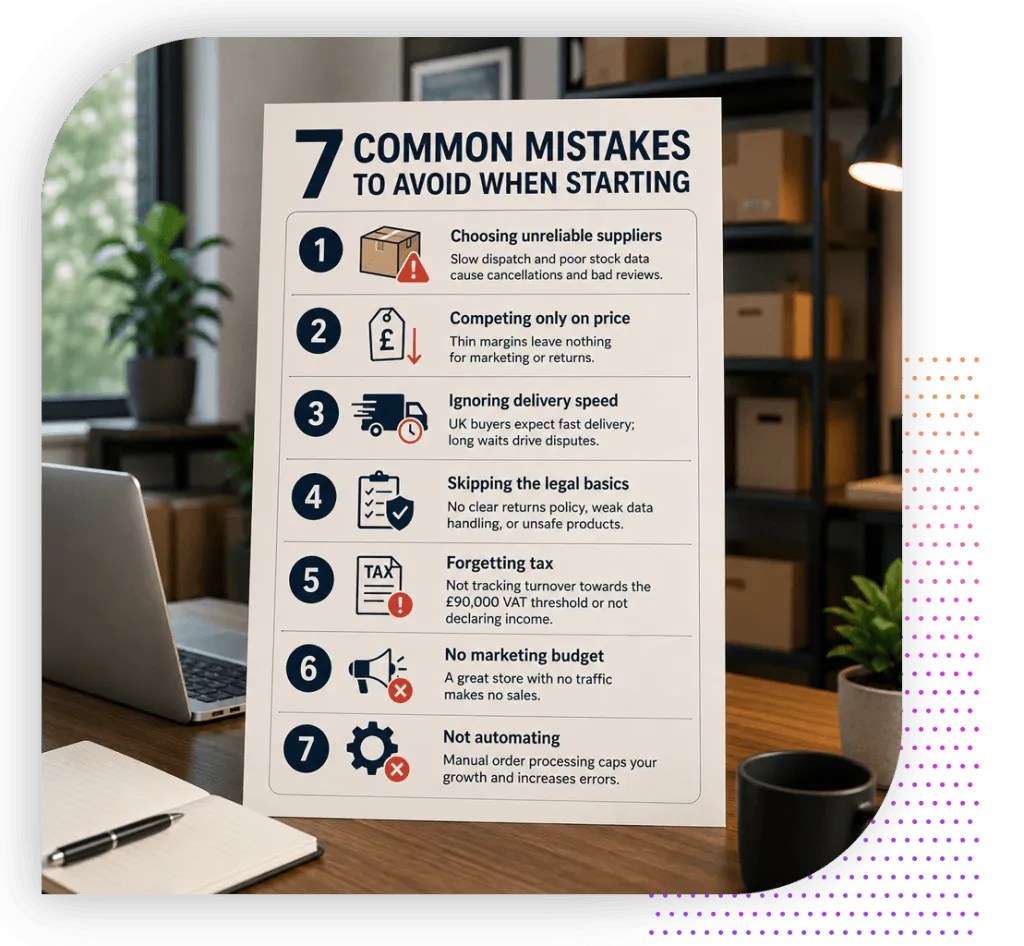
7 common mistakes to avoid when starting
- Choosing unreliable suppliers – slow dispatch and poor stock data cause cancellations and bad reviews.
- Competing only on price – thin margins leave nothing for marketing or returns.
- Ignoring delivery speed – UK buyers expect fast delivery; long waits drive disputes.
- Skipping the legal basics – no clear returns policy, weak data handling, or unsafe products.
- Forgetting tax – not tracking turnover towards the £90,000 VAT threshold or not declaring income.
- No marketing budget – a great store with no traffic makes no sales.
- Not automating – manual order processing caps your growth and increases errors.
Launch Checklist
Start Your UK Dropshipping Business with Verified UK Suppliers
Join thousands of UK retailers using Avasam to automate orders, source trusted suppliers and grow faster.

Frequently asked questions
How do I start dropshipping in the UK?
Because you do not need to purchase inventory before receiving an order, dropshipping can reduce the upfront cost of testing products.
Is dropshipping legal in the UK?
Do I need to register a business to start dropshipping in the UK?
Do I need a VAT number for dropshipping in the UK?
If you plan to sell products internationally, additional VAT and customs rules may apply. Our Brexit UK Dropshipping Guide covers these requirements in detail.