Brexit & UK Dropshipping: VAT, IOSS & Customs Guide 2026
 I ★★★★★ 4.5 on
UK-based · Founded 2018
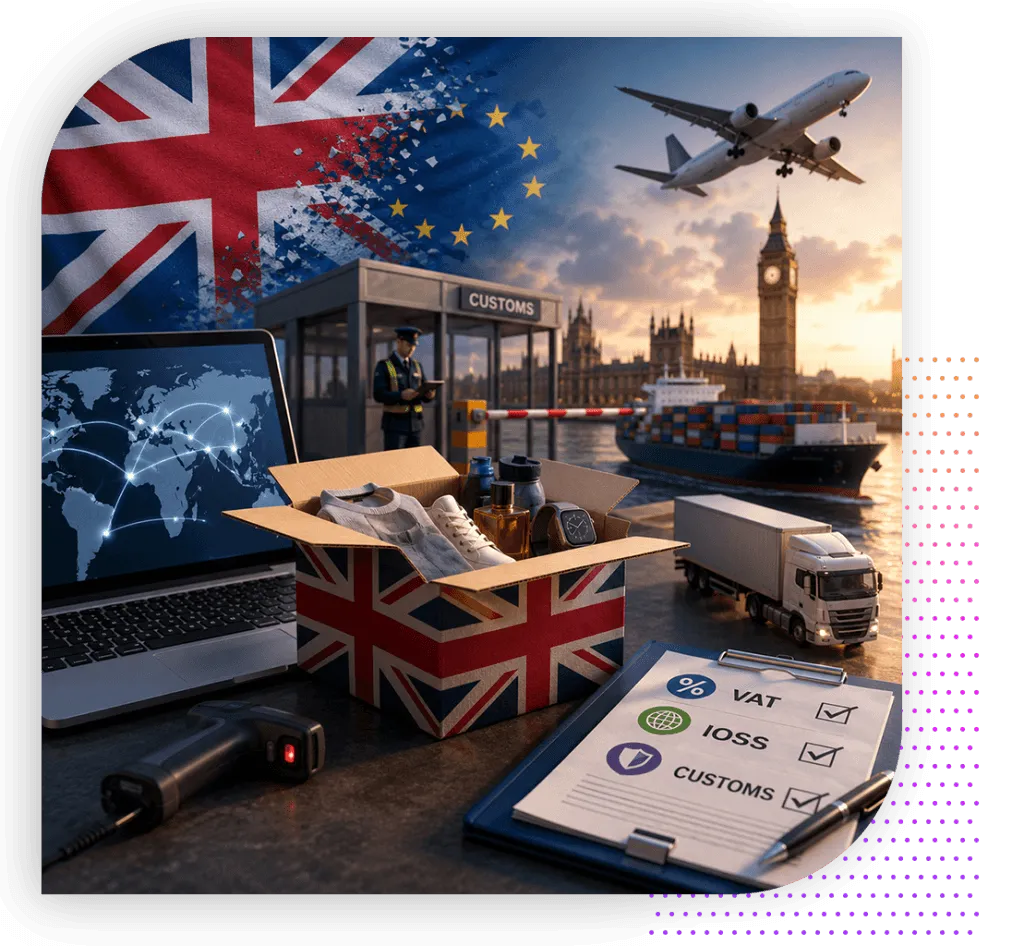
UK suppliers remove import VAT, customs declarations and border delays for most domestic UK orders.
Quick Answer
Brexit mainly affects UK dropshipping when goods cross the UK–EU border.
If you source products from UK suppliers and sell to UK customers, there are generally no customs declarations or import VAT on domestic orders. Most Brexit-related requirements such as EORI numbers, customs declarations and IOSS only apply when goods move internationally.
New to dropshipping?
Start with our complete UK Dropshipping Beginner Guide before sourcing products internationally.
Who Should Read This Guide?
- New UK Dropshippers
New sellers should also read our How to Start Dropshipping UK guide before choosing suppliers or sourcing internationally. - Shopify Store Owners
- Amazon Sellers
- WooCommerce Businesses
- eBay Sellers
- Businesses importing from the EU
- Businesses selling products into Europe
Also exploring UK suppliers?
Read our UK Dropshipping Suppliers Guide .
Key takeaways
- UK-to-UK orders are simplest. No import step means no import VAT and no customs declaration for domestic orders.
- Domestic VAT is unchanged. Register for VAT once turnover passes £90,000 (2026 threshold).
- Selling into the EU? The €10,000 cross-border threshold and IOSS/OSS schemes come into play.
- EORI is generally only needed if you import stock or move goods across the UK-EU border.
- Northern Ireland uses the Windsor Framework’s green/red lanes – get specialist advice if NI is in your market.
- Net effect: Brexit made UK-based sourcing more attractive, not less.
European dropshipping businesses are increasingly sourcing from local and EU-based suppliers to reduce shipping times and comply with post-Brexit import rules – a shift that is improving delivery speed and customer trust (Grand View Research). For UK sellers, that trend points clearly towards domestic suppliers as the lowest-friction route in 2026.
How has Brexit changed UK dropshipping?
Brexit ended the free movement of goods between the UK and the EU, so cross-border orders now involve customs declarations and potential import VAT that didn’t exist before. For dropshippers, the practical effects are:
- Customs declarations apply to goods crossing the UK-EU border in either direction.
- Import VAT can apply when goods enter the UK or the EU, depending on value and route.
- Selling into the EU now interacts with EU VAT schemes (IOSS/OSS) and a single EU-wide distance-selling threshold.
- Longer lead times and paperwork on cross-border orders raise the risk of delays and unhappy customers.
None of this makes cross-border dropshipping impossible – but it does mean sourcing from UK suppliers for UK customers is now markedly simpler than routing goods across the new border.
Related Reading
Do I pay import VAT when dropshipping in the UK?
For goods that a UK supplier ships to a UK customer, there’s no import step, so import VAT generally doesn’t apply – import VAT typically arises only when goods cross the UK-EU border, such as when you import stock from the EU.
For domestic VAT, the core rule is unchanged: you must register once your taxable turnover exceeds £90,000 in any rolling 12-month period (the 2026 threshold, in place since 1 April 2024); the deregistration threshold is £88,000. What Brexit changed is the cross-border picture – when goods move between the UK and the EU, import VAT and customs processes can apply, and how VAT is accounted for depends on where the goods start, where they end up and their value. See our UK VAT guide for dropshippers.
What are IOSS and OSS, and do I need them?
IOSS and OSS are EU VAT schemes you only need if you sell goods to consumers in the EU – they simplify how EU VAT is collected and reported.
- IOSS (Import One-Stop Shop) – lets you collect EU VAT at the point of sale for low-value consignments imported into the EU (up to €150), so customers aren’t hit with surprise charges on delivery. You register once and report through a single return.
- OSS (One-Stop Shop) – used for goods already within the EU that you sell B2C across EU borders, letting you report VAT for multiple EU countries through one return instead of registering in each.
A key trigger is the EU-wide €10,000 threshold for cross-border B2C sales: once your combined cross-border sales to EU consumers pass it in a calendar year, EU destination-country VAT rules apply. These schemes are optional but usually make EU selling far smoother. See our IOSS & OSS explainer.
Do I need an EORI number?
You generally need a GB EORI number only if you import stock into the UK or move goods across the UK–EU border – if you only sell goods that a UK supplier ships to UK customers, you may not need one at all.
An EORI (Economic Operators Registration and Identification) number identifies businesses moving goods into or out of the UK. Depending on your setup you may also need an EU EORI. Our EORI guide explains exactly when it applies and how to apply.
Need products already stocked inside the UK?

Importing stock from the EU
If you import stock from EU suppliers into the UK, expect customs declarations, potential import VAT and duty, and an EORI requirement – all of which add cost, paperwork and lead time compared with a UK supply chain. It can be made to work, but if speed and simplicity matter more than unit cost, sourcing domestically usually wins. Consider a customs agent if you import regularly, and see UK dropshipping suppliers for the domestic alternative.
Dropshipping from China or overseas to the UK after Brexit
If you dropship goods from China or other overseas suppliers to UK customers, a special VAT rule applies: for consignments valued at £135 or less sold directly to GB customers, UK supply VAT is charged at the point of sale rather than import VAT at the border – and the seller must be UK VAT registered to account for it. This rule has applied since 1 January 2021 and is still in force in 2026.
Here’s what it means in practice:
- Consignments £135 or less: you (or the online marketplace, if you sell through one) charge UK VAT at checkout and account for it to HMRC. There is no separate import VAT at the border. To do this you generally need to register for UK VAT, regardless of the £90,000 threshold.
- Consignments over £135: normal rules apply – import VAT and any customs duty are due at the border, plus a customs declaration.
- The £135 limit is based on the consignment value (excluding transport and insurance), not the price of individual items.
- The old £15 Low Value Consignment Relief has been abolished – there is no longer a VAT-free allowance for very low-value imports.
- Online marketplaces (such as Amazon or eBay) are usually liable for collecting this VAT when the sale goes through them.
This is one of the biggest hidden complications of overseas dropshipping into the UK – and a major reason many sellers prefer UK suppliers, where the goods are already in the country and these import-VAT rules simply don’t arise. Always confirm your obligations on GOV.UK or with an accountant before sourcing from overseas.
Do you charge VAT to EU customers after Brexit?
When you sell to consumers in the EU after Brexit, EU VAT – not UK VAT – is generally what matters, and how you handle it depends on the value of the goods and where they ship from. UK-to-EU sales are now exports from the UK, so they’re typically zero-rated for UK VAT, but EU import VAT and the EU’s schemes come into play at the other end.
The practical position is that selling into the EU usually means dealing with the EU’s €10,000 cross-border threshold and the IOSS or OSS schemes, and potentially registering for EU VAT. Below the €150 IOSS limit, IOSS lets you collect EU VAT at checkout so your customer isn’t surprised by charges on delivery; above it, import VAT and duty apply at the EU border. Because this adds cost and admin, many UK dropshippers focus on the UK market first. See our IOSS & OSS explainer for the detail, and confirm your specific obligations with an accountant.
What paperwork do you need for cross-border orders?
Cross-border orders between the UK and EU require customs paperwork that domestic UK orders don’t – chiefly a customs declaration, a commercial invoice and the correct product classification. Getting this right keeps shipments moving; getting it wrong is the main cause of goods being held at the border.
- EORI number – required to move goods across the UK-EU border (see our EORI guide).
- Commercial invoice – showing the goods, their value, the parties and the VAT treatment.
- Customs declaration – lodged for goods crossing the border, usually via a courier or customs agent.
- Commodity (HS) codes – the classification that determines duty rates and any restrictions.
- Country of origin – affects whether preferential tariffs under the UK-EU trade agreement apply.
For UK-to-UK orders sourced from UK suppliers, none of this is needed – another reason a domestic supply chain is the lowest-admin route. If you do trade cross-border regularly, a customs agent is often worth the cost.
Can I dropship to Northern Ireland? (Windsor Framework)
Yes, you can dropship to Northern Ireland from Great Britain, but NI has a distinct status under the Windsor Framework – the current arrangement, fully operational in 2026 – which governs how goods move from GB to NI through two channels:
- UK internal market lane (“green lane”) – for goods staying in Northern Ireland, with far fewer checks. Businesses generally need to be registered under the UK Internal Market Scheme (UKIMS) to use it.
- “Red lane” – for goods at risk of moving on into the EU, with full customs controls.
There are also specific rules for agri-food retail goods under NIRMS, including “Not for EU” labelling that is mandatory in 2026. NI trade is genuinely complex and evolving, so if you sell to or from NI, get specialist advice and see our Northern Ireland dropshipping guide.
How UK suppliers remove most Brexit headaches
Almost every Brexit complication above – import VAT, customs declarations, IOSS/OSS, EORI, the GB–NI lanes – arises because goods are crossing a border, so sourcing UK suppliers for UK customers sidesteps nearly all of it. The goods are already in the country, so for those domestic orders there’s no import step at all.
That’s why, post-Brexit, a UK-first supply chain is the simplest, fastest and lowest-risk model for most UK sellers. Avasam connects UK sellers with verified UK suppliers and automates the order flow across Shopify, eBay, Amazon and WooCommerce – so you can focus on selling rather than customs paperwork.
Advantages of Using UK Suppliers
Key terms explained
Related Guides

Frequently asked questions
Is dropshipping still worth it in the UK after Brexit?
If you’re considering entering the market for the first time, our step-by-step UK dropshipping startup guide covers everything from choosing suppliers to launching your first store.